Welcome to BTABoK
By
Paul Preiss
•
“This is my professional journey, my unique experience, and my philosophy is to accept outcomes as they arise.” Leonard Nimoy
Distinctive Qualities of the BTABoK
- Foremost, BTABoK unites all architectural disciplines rather than creating further segmentation. Its models, from competency to engagement, streamline architectural work by providing inclusive frameworks for diverse practitioners—spanning business, information, infrastructure, software, and solution architecture.
- BTABoK represents a highly pragmatic toolset. Organizations can implement it holistically or adopt individual assets, such as the architectural decision record, while maintaining consistent messaging and principles. Difficult challenges are systematically addressed to strengthen architectural practices in a flexible and robust manner.
- It serves as a foundational knowledge repository, supporting the storage and sharing of architectural artifacts—including business capabilities, patterns, views, and quality attributes. BTABoK enables active curation and utilization of comprehensive architecture examples.
- BTABoK is incrementally adaptable and supports globally recognized career development. It accommodates implementation at various organizational levels—individual, corporate, vendor, or systems integrator. Engagement models leverage shared knowledge while allowing proprietary differentiation. The framework is compatible with both large- and small-scale architecture practices and supports varying levels of agility.
- As an open-source resource, BTABoK is professionally curated. Certified architects review and assess all submitted contributions. Ongoing enhancements, including advanced Git-based tools, are planned to ensure continued improvement and governance.
We anticipate that this comprehensive knowledge base and its foundational tenets may generate debate among seasoned architects and industry professionals. Such discussions are encouraged, as they contribute to the evolution and maturation of the profession. The vision for the industry emphasizes merit-based recognition, requiring leadership, tangible contributions, humility, and demonstrated professional success.
BTABoK Onboarding Process
BTABoK comprises the most extensive and integrated body of architectural knowledge currently available. It synthesizes concepts from across the discipline, providing systematic and practical tools for nearly every facet of architectural implementation.
To initiate BTABoK adoption, architectural teams should review this material comprehensively for orientation and guidance. Next, teams should define entry points aligned with organizational objectives. Some enterprises integrate BTABoK fully within a project, while others prioritize a phased or hierarchical approach.
Defining Digital Advantage
Digital transformation often functions as a vendor-driven term associated with substantial investment and change management. The BTABoK distinguishes itself by centering value realization from transformation rather than the transformation process itself. Digital advantage reflects the measurable benefits organizations pursue through digital transformation. By emphasizing outcome-based metrics, BTABoK ensures technology initiatives are evaluated by their tangible business impact. The goal is to professionalize and standardize outcome-driven digital investment practices, positioning architects as pivotal contributors distinct from other technical roles.
Content Structure Overview
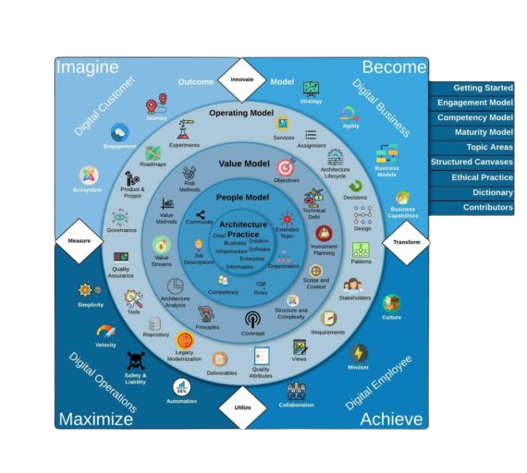 The right-hand navigation facilitates access to semi-segregated areas of knowledge and practice within BTABoK and Iasa. Key frameworks—including the engagement, competency, topic area, maturity, and structured canvas models—operate synergistically under BTABoK for maximum practitioner value.
IBAM: Strategic Focus Areas
BTABoK strategically focuses on delivering outcomes across four critical domains: digital customer, digital business, digital employee, and digital operations enhancement. These focal points define the organization's digital strategy and architecture maturity.
These dimensions serve as the primary metrics for assessing organizational outcomes and the efficacy of its architectural capabilities.
Current assessments indicate that most architectural programs prioritize operational maximization, highlighting an opportunity for a more balanced strategic focus.
Continuous Value Creation (Diamonds)
BTABoK regards innovation, transformation, utilization, and measurement as continuous organizational activities, not linear phases. While corresponding to lifecycle management, these activities are ubiquitous and involve internal and external stakeholders.
Architects and organizations are advised to regard these dynamics as forces to leverage and optimize, rather than processes to control.
Outcome Model
The outcome model encompasses the enterprise-wide objectives attributable to digital advantage and forms the basis for architectural performance measurement in correlation with the Maturity Model framework. Articles within this domain specify impact alignment (IBAM), operational approaches, and delivery models.
The outcome model should drive all architecture initiatives and commitments, extending to vendors and service integrators, who are accountable for achieving measurable business value within their mandates. This cross-functional responsibility encompasses both business and technology perspectives.
Operating Model
The operating model details the principal practices, processes, techniques, and tools that constitute the day-to-day operations of architectural teams, including roadmapping, requirement management, and decision facilitation.
Value Model
This model formalizes techniques for quantifying quality, value, and outcomes within architectural practice, bridging the operating and people models. Ownership of results is prioritized over advisory-only roles; measurement is conducted both at business and engineering levels, with methodologies such as Architecture Analysis, principles development, technical debt management, and value assessment embedded.
People Model
Focused specifically on the organizational and human factors in architecture, the people model outlines structures for organizing, defining roles, cultivating community, and scaling architectural functions. It is interconnected with the separately maintained competency model to ensure alignment between individual skills and organizational needs.
Architecture Practice Article
This article synthesizes the goals and methodologies used by architecture teams to contribute to broader organizational objectives, emphasizing the distinction between professional practice models and traditional employment structures.
Engagement Model: Core Framework
BTABoK’s engagement model standardizes the approach and terminology employed by architectural teams, regardless of their size. It enables alignment with organizational stakeholders through shared tools and methodologies, while allowing tailored adoption to meet specific team or project needs. Cross-references to other frameworks (TOGAF, Disciplined Agile, ITIL, COBIT, SAFe, etc.) facilitate interoperability and ongoing evolution.
Competency Model: Individual Architect Development
This model provides a mature framework for defining, assessing, and developing architectural competencies. It is used for professional training, certification, and career progression, with downloadable assessment criteria available for organizational HR integration.
Maturity Model
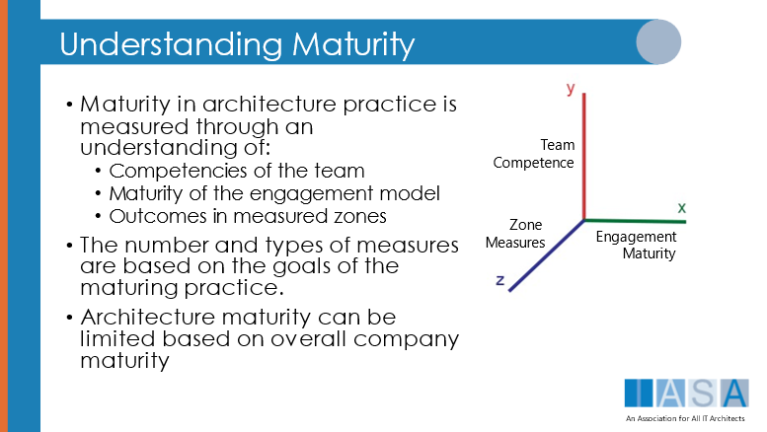
The maturity model evaluates both organizational architecture capability and its contribution to digital advantage, integrating outcome measurement, engagement model maturity, and practitioner competencies.
 Structured Canvas Approach
The Structured Canvas Approach (SCA) delivers a suite of modular ‘cards’ and ‘canvases’—tools for focused, collaborative architectural thinking. Canvases support multi-stakeholder engagement, while cards address targeted activities. Their design fosters clarity, eliminates ambiguity, and ensures workflow alignment. All tools are customizable and open source, subject to licensing for commercial use. Practitioners are encouraged to contribute enhancements to the broader BTABoK ecosystem.
Integrated linkages between canvases provide cohesive decision support across all stages of architectural solution development and refinement.
Topic Areas
BTABoK incorporates deep, evolving knowledge domains—ranging from cloud to security, integration to AI—via specialized working groups. These topic areas expand BTABoK’s scope and may support additional certifications or badges for architects. New working groups are anticipated as BTABoK matures.
BTABoK Adoption Strategy
BTABoK’s objective is cross-industry adoption, fostering practical implementation and ongoing improvement. It acts as an industry standard, complementing existing frameworks by providing unifying competencies and methodologies.
Organizations should begin by familiarizing themselves with the Architecture Practice Model, advancing to engagement model implementation. Iasa provides adoption scenarios complete with diagrams, case studies, and video support, covering key use cases such as stakeholder management and traceability. Organizations are encouraged to contribute real-world experiences for community enrichment and continuous improvement.
Corporate Adoption
Comprehensive BTABoK integration within organizations requires leveraging both internal and external architectural knowledge for collective advancement.
Typical corporate adoption steps include:
- Assessment of individual architects against the competency model
- Evaluation of the architecture practice using the engagement model
- Development of organizational architect training plans
- Establishment of mentorship initiatives for architectural staff
- Project-level implementation of the Engagement Model
- Leadership advisory and steering group development
- Collaboration with other Iasa corporate members and the broader community
Vendor and System Integrator Adoption
Maintaining a cohesive architecture practice is challenging for vendors and integrators, due to varied client maturity, misalignment between vendors and clients, and frequent staff turnover. BTABoK provides a standardized methodology to overcome these obstacles, minimizing risk and maximizing client value realization.
Government and NGO Adoption
Mission-driven organizations often encounter complex challenges, heightened safety considerations, and value measurement difficulties. BTABoK supports federated adoption methods across public sector structures, enabling coordinated architecture delivery amidst complexity and funding constraints.
For-Profit Adoption
BTABoK’s methodologies have been successfully applied in diverse commercial sectors. As technology becomes increasingly central to business models, adoption in traditional enterprises accelerates digital differentiation and competitive advantage.
SME Adoption
Small and medium-sized enterprises represent an under-served market for professional architecture services, despite their acute need for success in technology initiatives. BTABoK is extending its methods specifically for the SME sector as part of its ongoing development plan.
Individual Adoption
Individual practitioners can adopt BTABoK incrementally, leveraging the engagement and competency model articles to refine skills and enhance architectural delivery capabilities.
Strategic Implementation: Think Big, Start Small, Move Fast
Successful adoption requires a strategic commitment to continuous improvement and organizational growth. Iasa recommends a phased approach—starting with manageable initiatives and maintaining a long-term vision for architecture advancement.
About the Author
Paul Preiss
Click to see all articles by this authorCopyright & License
Copyright © 2026 Iasa Global
All rights reserved. This content is provided by Iasa Global, the premier association for IT architects worldwide.
Creative Commons License
This work is licensed under a Creative Commons Attribution-NonCommercial-ShareAlike 4.0 International License.
You are free to share and adapt this material for non-commercial purposes, provided you give appropriate credit and distribute under the same license.Related Articles
Content Information
8 minutes
Intermediate